

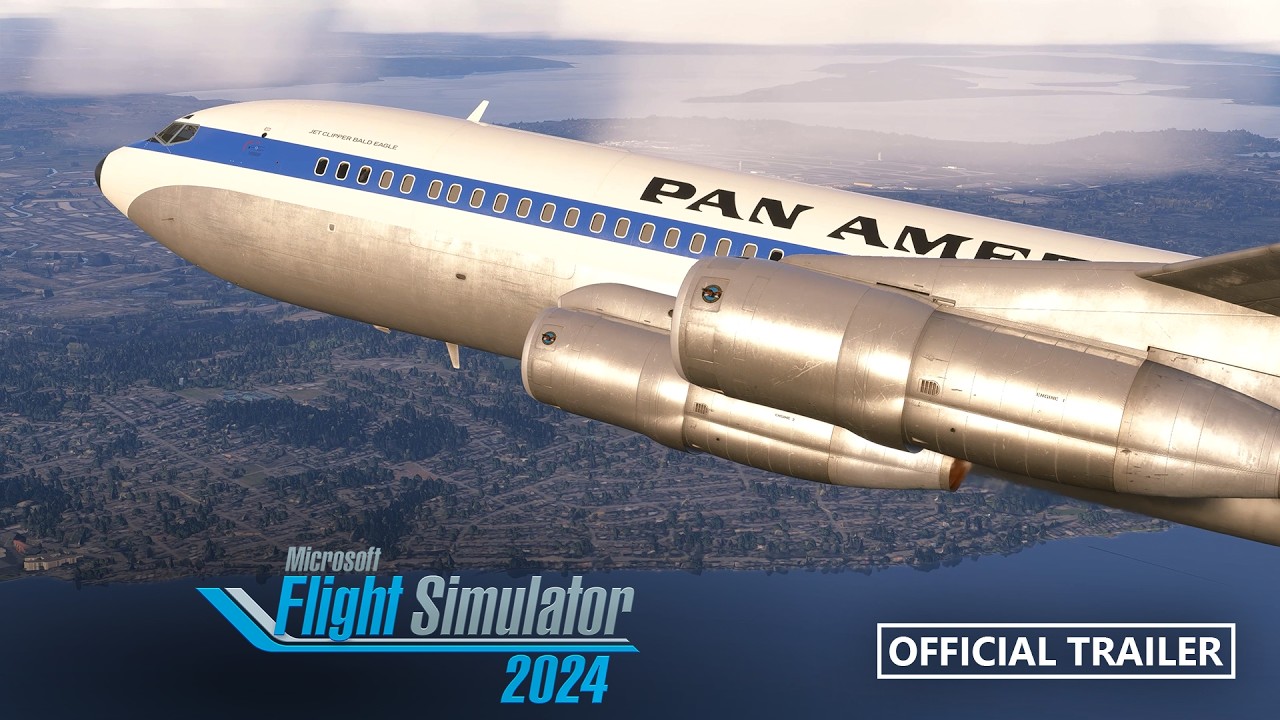
Earlier this week we released a revamped Famous Flyer 10: Boeing 707-320C for Microsoft Flight Simulator 2024, developed by Working Title and iniBuilds. To celebrate this launch, we recently asked Chris Burnett, one of the founders of Working Title, some questions to get a behind-the-scenes look at this new airliner!
The Boeing 707-320C is a collaboration between both Working Title and iniBuilds. Could you provide details on each team’s area of work for this complete rework?
Yes, we were very excited to work with iniBuilds on the aircraft model – inside and out, as well as the audio. The iniBuilds team took the lead on finding visual references and even visited several aircraft, along with leading the audio effort. Getting the interior modelling right was a challenge because there are really not any remaining aircraft with the exact original cockpit or aircraft configuration, so we worked with quite a few reference sources to put together the best possible simulation experience.
The Working Title team focused on the main simulation, including all of the aircraft systems, avionics, flight modelling and all aircraft interactions and behaviors. We spent quite a bit of time simulating as many of the 707’s manual systems, including pretty deep simulations of the pneumatic, electrical and hydraulic systems. We also went deep into some of the compass and gyro simulations as well.
This aircraft was flown with three or more flight crew members in the flight deck. What features have you incorporated to make it easier for single-pilot operations in the sim?
We knew from the start that this aircraft would pose a challenge for simmers if simulated in depth – we wanted to simulate all of the systems, but we also wanted to make the plane approachable and fun to fly. To tackle this we built a custom EFB app for the plane that features a long list of convenience options and, more importantly, a virtual flight engineer. The VFE has 12 complete cockpit flows that feature aural callouts as well as localized text captions for each step being completed. This feature accomplishes two separate objectives – first it creates a really immersive environment that reflects the real world operation of this aircraft; second, it is a great learning tool because you can listen and follow along visually with the VFE as checklist items are completed. The user manual highlights all of the options and capabilities, but we think the Boeing 707 EFB is pretty intuitive to use.
Could you talk through some of the available navigation options in this aircraft?
The Boeing 707-320C comes with three long-range navigation options – the CIVA INS, the Garmin GNS 530 and the Universal UNS-1. We chose these three options because all have been installed in real aircraft at some point in the history of the aircraft and these options provide the greatest flexibility for users.
The CIVA INS is the classic choice and must be combined with traditional radio navigation to work effectively. Traditionally, the CIVA INS is used for the enroute/long-range portion of the flight, while departures, arrivals and approaches were accomplished with radio navigation (VOR, NDB). The CIVA modelling includes drift and error correction, and a dedicated CIVA tab on the EFB app provides users the option of skipping the tedious process of manually setting up the flight plan if they wish. Drift and alignment time are also configurable options, along with options for including or excluding arrival and departure procedures, depending on their preference. Sim pilots should note that while these procedures can be loaded into the INS, they need to be cautious about short legs and sharp turns because this technologically simple (in modern terms) navigator has no real concept of turn anticipation or turn radius – it simply navigates point-to-point with a fixed turn anticipation value, so it is easy to overshoot turns when relying on the autopilot.
The GNS and UNS provide more modern options with two different form factors – the GNS offers users with a moving map, and this is the only navigation option that includes a map. The UNS offers a more modern CDU interface that will feel familiar to simmers that generally prefer airliner options.
We simulated a fairly sophisticated GPS steering adapter when these modern navigation units are paired with the autopilot, but it is still possible to trip up the autopilot, especially when trying to make tight turns at high speeds. We also simulated the support for non RNP-AR glidepaths, so users can couple an RNAV approach with vertical guidance…if they get all the switches in the right positions.
All of the navigation options can easily import flight plans from the sim’s flight planner – for the GNS and UNS-1, this process is the same as in other aircraft – using the SEND TO AVIONICS button on the EFB is all that is required. For the CIVA INS, we included this functionality into the CIVA EFB tab itself, to allow users to select whether they want procedures or not. There are examples and details of this in the user manual.
What’s your personal favorite attribute of the Boeing 707, and which element was the most interesting to work on during development?
I am a big fan of classic aircraft, and there is a special place in my heart for classic analog gauges. There is something very tactile and engaging about working with analog gauges and having to manually configure the many aircraft systems that have been automated over the years. For me, this plane is a treat to fly because it keeps you active and engaged through every phase of flight. As a simmer of 30+ years myself, I really love the immersion of the callouts and cockpit flows that the VFE delivers and, to me, that is probably my favorite attribute of the plane.
What was the most challenging part of developing this aircraft, and did it being an aircraft developed in the 1950’s factor into that challenge?
Many aspects of the development were challenging, but three big ones come to mind:
1) The lack of definitive references was definitely a challenge – this aircraft involved a great deal of research that went beyond the usual scope of developing a more modern aircraft. There is no one definitive flight manual – I think we collected more contradictory references for this project than any other, but it was a fun challenge to reconcile them. Fortunately, I have a friend in the USAF that used to fly on one of the 707-derivitave aircraft, so he and his network were a huge help for me.
2) Making the aircraft both approachable and complete from a systems perspective created a challenge we hadn’t had to solve for before – this is how we ended up with such a comprehensive EFB with the virtual flight engineer. We knew we didn’t want to simplify things because the simmer audience craves that level of detail, but at the same time we knew we didn’t want to turn away part of the audience by making the aircraft too hard to operate. I am hopeful that simmers are happy with the solution we landed on.
Tex Johnson famously performed a barrel roll in the Dash-80 prototype of the Boeing 707 in the 1950’s. Have you tried to replicate this impressive feat in the sim?!
We did test this out and it is, in fact, a challenge. We really don’t have a lot of details on exactly how it was done, but that hasn’t stopped us from testing it out… Screenshots attached
A few interesting facts about this. It was attempted more than once, and one of those instances – attempted by a Lufthansa training flight, ended in disaster. It is quite easy to end up in an unrecoverable attitude that leads to a crash or in-flight breakup, and plenty of our attempts ended that way.
So, yes, it is possible. No, it is not recommended…though I doubt that will stop simmers from trying and reporting their successes or failures…
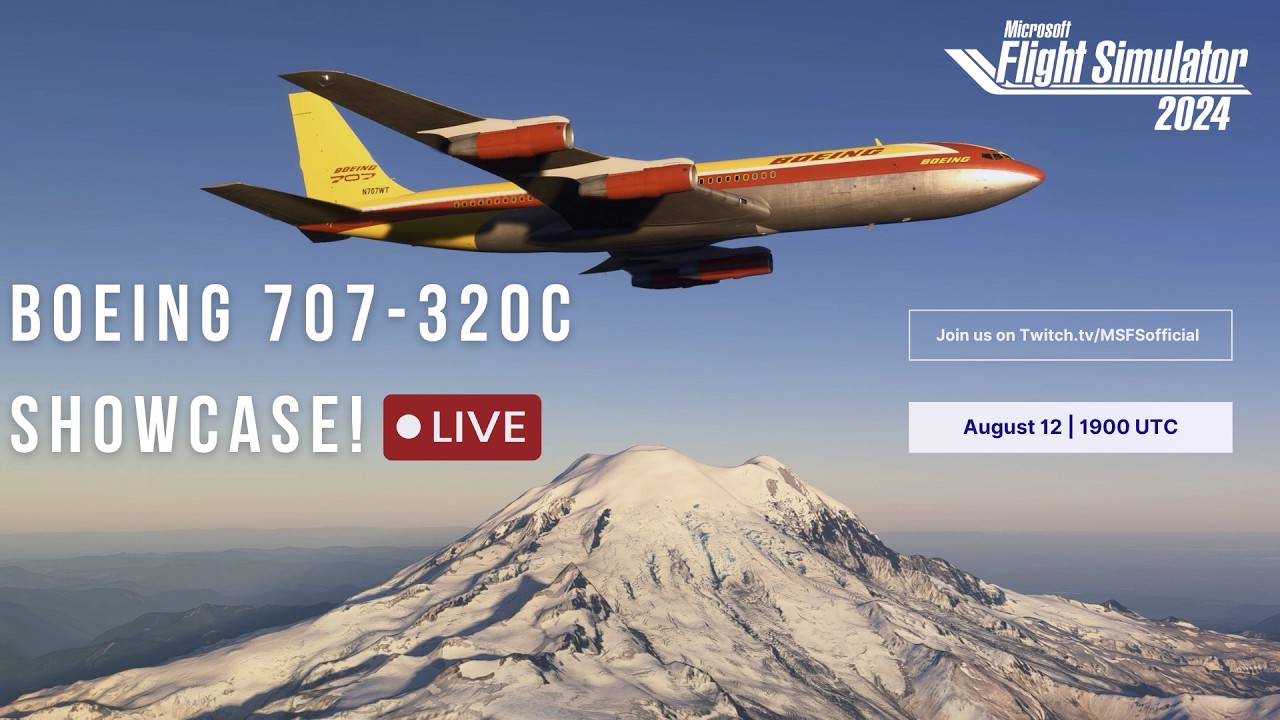
Chris joined Matt from the Microsoft Flight Simulator Community Team for a Twitch.tv livestream, showcasing the Boeing 707 and its many features, which you can watch on replay now!
Microsoft Flight Simulator 2024 is available for Xbox Series X|S and PC with Xbox Game Pass, PC Game Pass, Windows, and Steam, PlayStation 5, and on supported mobile phones, tablets, and lower-spec PCs via Xbox Cloud Gaming. For the latest information on Microsoft Flight Simulator stay tuned to @MSFSOfficial on X.