
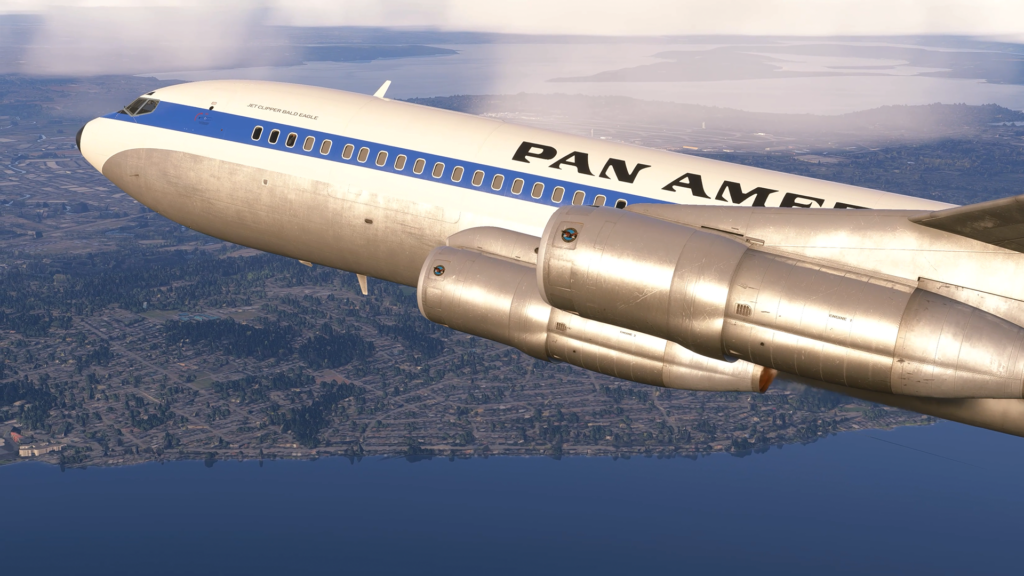
Experience the stunning authenticity of one of aviation history’s most renowned aircraft!
ONE OF AVIATION’S BOLDEST JOURNEYS
The 707-320C was the most successful, most produced variant of the famed Boeing 707 family of long-range jetliners. It was the culmination of years of inspired innovation and painstaking engineering.
The late 1940s witnessed blazing advances in aviation technology, with the recently emerged jet engine at the forefront of these sweeping innovations. Boeing, renowned for its World War II-era piston-powered bombers like the B-17 Flying Fortress and the B-29 Superfortress, embraced the jet engine, using it as the basis of their innovative post-war designs. Boeing’s B-47 Stratojet, a high-altitude, long-range strategic bomber powered by six turbojet engines, took its maiden flight in 1947. The aircraft incorporated several innovations including engine pods and a swept wing design. In April of 1952, the Boeing B-52 Stratofortress, which shares several design elements with the B-47, took its maiden flight. The bomber has proven to be one of the most successful aircraft in history, with advanced iterations still operating.
In the same month that the B-52 took its maiden flight, Boeing made a bold and risky decision: the company would undertake the secret, self-funded development of an aircraft with similar design features to the B-47 and the B-52, but intended as a proof-of-concept platform for commercial and general military utility use. They would build just one and use it as a demonstrator to generate interest for production variants. The decision was a gamble for many reasons, notably that the public was not yet warm to the idea of jet-powered passenger aircraft. The expense of development could potentially bankrupt the company if it didn’t yield significant orders.
AN ICON TAKES FLIGHT
Just over two years after Boeing’s decision, on July 15, 1954, the clandestinely developed aircraft took its maiden flight. Officially designated the 367-80 and nicknamed the “Dash 80,” the aircraft had a swept main wing and was powered by four pod-housed turbojet engines. Its demonstration flights, which famously included unannounced barrel rolls, impressed both airline executives and military decision makers.
Development then began on a new airframe based on the Dash 80, the 707. The first iteration of the quadjet airframe, the 707-120, took its maiden flight on December 20, 1957, and was introduced on October 26, 1958, flying for Pan American Airways. This first lineage of the 707 marked the beginning of a historic line of 7×7 series aircraft that continues to this day.
A REFINED ICON
Boeing introduced the 707-320C, the final version of the 707 line, in the early 1960s. The -320C was a “convertible” (hence “C”) variant, able to serve as a passenger carrier or as a freighter. The C was an enhanced iteration of the 707-320B, the most visually distinguishing feature of the C being the addition of a fuselage cargo door. The -320C also boasted an updated wing with three leading-edge flaps for improved take-off and landing performance.
The 707-320C was the most successful and the most numerous of the 707 family with 337 units manufactured. Airlines including Northwest, Pan Am, Air France, and Braniff flew the airframe on routes throughout the world. Produced until 1978, the 707-320C flew into the early 21st Century.
During its operational tenure, the 707-320C was crewed by three (a captain, a first officer, and a navigator) and could carry up to 219 passengers, 13 pallets of cargo, or a combination of both. The aircraft measures 152 feet, 11 inches in length, stands 42 feet tall, and has a wingspan of 145 feet, 9 inches. It was powered by four wing-mounted Pratt & Whitney JT3D low-bypass turbofan engines, each developing up to 19,000 pounds of thrust. The jetliner had a range of 3,337 miles with maximum payload, or 5,700 miles with maximum fuel, and it cruised at 604 miles per hour.
RELIVE THE THRILL – THROUGHOUT THE GLOBE
The Microsoft Flight Simulator 707-320C celebrates this magnificent aircraft by highlighting it as its tenth Famous Flyer.
This simulation, developed jointly by Microsoft partners iniBuilds and Working Title, comes complete with operable cargo door, galleys, and 707-specific exterior animations, from the tab-driven control surfaces to the JT3D engines’ blow-in doors. The aircraft ships in three historically accurate cockpit configurations: the Carousel IV-A inertial navigation system, the UNS-1 FMS (Universal Navigation System – 1 Flight Management System) with RNAV (aRea NAVigation) capability for modern airways, and the Garmin GNS (Global Navigation System) 530 — a unit some 707s still carry in service today.
Experience the thrill of lifting this icon of the Jet Age into the sky and taking it throughout the world in Microsoft Flight Simulator. This release is packed with an incredible array of highly-detailed, ultra-authentic features:
Three Unique Navigation Experiences
The aircraft ships in three cockpit configurations — and all three are historically accurate. The 707 flew long enough to be retrofitted with every generation of navigation equipment, so each pilot can pick the configuration that matches their preferred way of flying.
- Carousel IV-A INS (Inertial Navigation System) — the classic fit, and how the 707 actually crossed oceans: before satellite navigation, far beyond the reach of land-based navaids. Full alignment procedure, position drift, waypoint management, in-flight position updates.
- UNS-1 FMS — RNAV capability for flying modern routes and procedures.
- Garmin GNS 530 — GPS (Global Positioning System) navigation for pilots who want to focus on the airplane, not the navigation. Some 707s still flying today carry exactly this unit.
Comprehensive CIV-A INS Simulation
The Carousel IV-A is simulated end-to-end: alignment, inertial drift, position updating and drift correction, waypoint sequencing, and distance and time calculations. Alignment comes in three modes — realistic (over 10 minutes, as in the real aircraft), fast for a shorter wait, or instant, which allows the pilot to immediately begin flying. Drift error can be switched off entirely for simplified navigation.
The physical Carousel IV-A could be programmed with just 9 waypoints; on long routes, crew needed to re-enter waypoints as slots opened along the flight. The Virtual Navigator can take over this task: it imports the route from the flight planner and keeps the unit fed continuously until the destination is reached. Flight Simulator pilots who prefer the original experience can enter each coordinate manually for an authentic feel.
The Carousel IV-A was built for ocean crossings, not the terminal area — the real unit knew nothing of SIDs (Standard Instrument Departures) and STARs (Standard Terminal Arrival Routes). As an option, procedures can be imported into the unit, so even the INS-equipped aircraft remains fully compatible with the sim’s modern airspace and RNAV procedures.
Virtual Flight Engineer
The Virtual Flight Engineer (VFE) assists with workload: guided flows, voice assistance, and optional automation from cockpit preparation through shutdown and securing the aircraft. Engine start stays in the pilot’s hands by design — the flows bring the aircraft to the point of engaging the starter and introducing fuel. Once engines are powered, the VFE assumes control. None of this happens silently: switches flip, knobs turn, and checklist items are called as they’re completed—the cockpit comes to life around the pilot. In flight, the VFE can manage pressurization and fuel tank switching; these fuel management tasks required continuous crew attention in the physical 707. With this system, the pilot triggers each and every task flow, delegating work while remaining in command — as the captain should.
EFB (Electronic Flight Bag) Companion Application
The Microsoft Flight Simulator Boeing 707-320C includes a dedicated companion application built into the MSFS 2024 EFB ecosystem, working alongside the sim’s own EFB apps — the checklist app, the plane loader, and the flight planner. It covers aircraft configuration, door controls, performance calculations, INS support tools, and operational utilities.
Realism, Adjustable
- Automations can take over recurring in-flight tasks: fuel temperature management, air sources, EPR (Engine Pressure Ratio) bug positioning, fuel balancing and tank selection.
- Realism options allow era and workload to be selected per system:
- Altitude selector — alerter, as in the real aircraft, or preselector, letting the autopilot capture the selected altitude — something the historical unit could not undertake.
- CIV-A procedures — optional SID and STAR import into the INS.
- Chronometer — simplified or fully simulated (down to winding it before flight).
- HSI (Horizontal Situation Indicator) — historical behavior (unintuitive enough that it was discontinued on the physical aircraft) or modern, with automatic course slewing for a localizer or FMS track.
- Parking brake — realistic or simple.
- Additional options include automatic window shade management throughout the cabin and Flight Engineer callouts.
Performance Planning and Data Cards
The aircraft allows take-off and landing data to be calculated in the EFB, including V-speeds, stabilizer trim, runway requirements, EPR targets, landing reference speeds, and field lengths. Calculated values can be transferred directly to aircraft instruments when applicable.
Deep Pneumatic and Environmental Simulation
The aircraft features a fully simulated pneumatic and environmental control architectures, including engine bleed air, APU (Auxiliary Power Unit) bleed air, turbo compressors, pneumatic ducting, air-conditioning packs, coolant air systems, and their operational interactions.
Pressurization System
A complete pressurization simulation models cabin pressure management, outflow valve operation, landing mode functionality, cabin altitude behavior, and realistic cockpit controls.
Electrical System Simulation
Multiple generators, external power, battery buses, APU generation, bus-tie logic, and essential power distribution are simulated, encouraging authentic Boeing 707 operating procedures.
Authentic Flight Controls
The 707 used flying elevators and flying ailerons — the pilot moves a tab, and aerodynamics move the surface. That architecture is reproduced here, along with the handling that accompanies it.
3D Model
A fully modeled exterior and interior, capturing full authenticity of the 707 — the low-slung fuselage on tall gear, 35 degrees of wing sweep, four JT3Ds on underwing pylons, the ventral fin, the fin-tip HF (High Frequency) antenna probe, and a cockpit that is pure 1950s: eyebrow windows, analog instruments, a chronometer that needs winding, and a modeled flight engineer and navigation station.
The -320C was a convertible airframe — passengers, cargo, or both — and this model recreates the combi layout: main deck cargo section between the cockpit and the cabin, with passenger cabin aft of the wing. The interior is complete: cockpit, forward and aft galleys, lavatories with opening doors, and a passenger cabin with working lighting controls and window shades, manual or automatic. The main-deck cargo hold carries visible containers, the large cargo door is operable, and two courier/cargo-master seats sit forward of the cargo section, each with configurable occupancy — as on the physical aircraft, where a cargo master sat. Even the galley service door is modeled at its true, airline-cart size — anyone taller than the cart ducks.
On the ground, the aircraft is serviced like the physical 707-320C: passengers board through the rear cabin stairway, lower baggage compartments open alongside the main deck, and ground service equipment, chocks, animated doors, and servicing interactions complete the turnaround.
On its exterior, the control surfaces behave like those of the physical 707-320C. The aircraft’s elevators and ailerons are aerodynamically driven: the pilot’s control inputs move only small tabs, and airflow completes the action. The model shows it; park the aircraft and move the controls. Only the tabs deflect; in flight, the surfaces follow.
The engines function with similar authenticity. The JT3D’s Inlet Guide Vanes — a feature specific to this engine and rare by modern standards — are fully modeled, along with the blow-in doors around the inlet, and all mechanics are simulated. Furthermore, turbocompressors appear on three engines, matching the real installation.
Custom Autopilot and Flight Directors
This feature includes heading, navigation, approach, altitude hold, and navigator-coupled modes. These systems are modeled authentically for the period; they help the pilot fly the 707 as these systems did in the physical aircraft, they do not fly it for the pilot.
Gyroscopic Navigation and Compass Systems
This includes directional gyro behavior, comprising earth-rate and transport drift, synchronization procedures, magnetic-following and manual correction modes, and a backup compass.
Bendix RDR-1 Weather Radar
One of the first weather radars ever fitted to airliners, simulated as it worked: a green display painting precipitation in white. Radar tilt is functional — making this one of the first MSFS aircraft to simulate this functionality — and the horizontal sweep covers a notably wide field.
Windable Clock
The cockpit chronometer runs on a spring, not a battery. One full winding lasts eight days — but a pilot who forgets will find out the way real crews did. Elapsed time, sweep second hand, and setting logic all follow the original unit.
Water Injection Operations
The optional water injection system reproduces a defining feature of the JT3D-3B: injecting water into the engines to recover thrust when hot or high-elevation conditions would otherwise eat into take-off performance. The simulation includes realistic thrust and EPR characteristics for wet take-offs, and the water supply is finite — as on the real aircraft, it lasts for the take-off and not much longer. The trademark black smoke trails of a wet 707 departure are part of the package.
Modern Platform Integration
The aircraft is fully integrated with Microsoft Flight Simulator 2024 features including Career Mode compatibility, virtual reality support, modern EFB workflows, and extensive aircraft interaction systems.
These features make the Boeing 707-320C one of the most exciting ever offered for Microsoft Flight Simulator users. The beautiful reproduction and functional authenticity make this offering an absolute must-have! Get it now in the In-Sim Marketplace for $14.99. The sky is calling!
Microsoft Flight Simulator is available for Xbox Series X|S, Game Pass, PC, PlayStation 5, PS VR2, Steam, and supported mobile phones, tablets, and lower-spec PCs via Cloud Gaming. For the latest information on Microsoft Flight Simulator, stay tuned to @MSFSOfficial on X, Instagram, Facebook, and TikTok.