
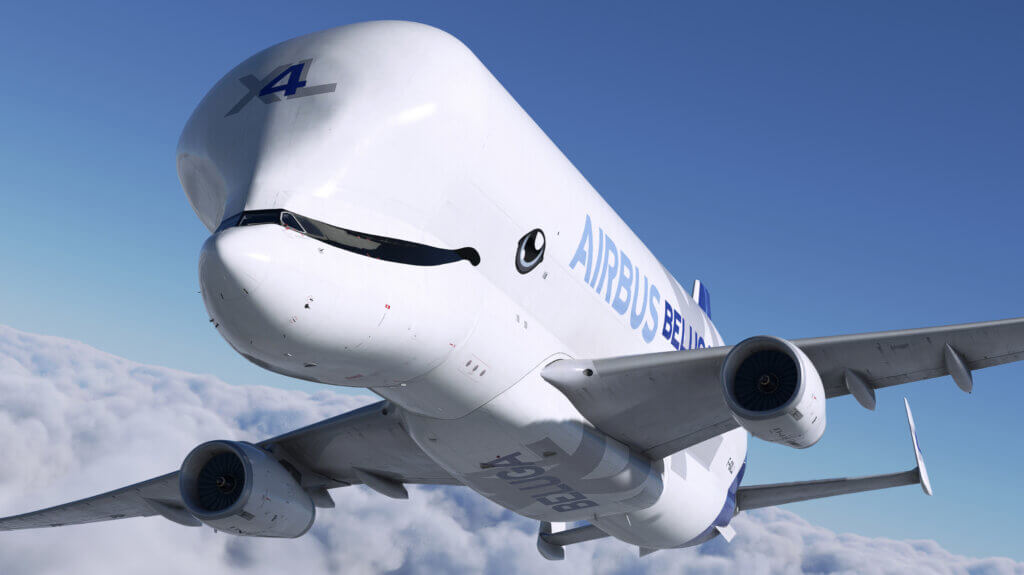
One of the world’s largest, most specialized, and distinctive aircraft is now available in the Microsoft Flight Simulator (2020) Marketplace.
A Marvel of Specialization
The BelugaXL is a specialized high-volume cargo aircraft developed by European aviation consortium Airbus. The distinctive, twin-engine BelugaXL is an integral logistical component in the airliner manufacturing process at Airbus. The BelugaXL is used to transport key aircraft components, notably wing assemblies, fuselage sections, and tail units, between production facilities located throughout Europe. It is also used for non-Airbus global outsize freight service. The BelugaXL took its maiden flight on July 19, 2018 and it entered service on January 9, 2020. Airbus has manufactured a total of six BelugaXLs.
Critical Aerial Transport System
The BelugaXL was developed specifically to serve the unique logistical needs of the Airbus distributed manufacturing process. The company, founded in 1970 through the merger of several European aviation firms, produces aircraft components across several countries. This manufacturing arrangement requires the transnational transport of large substructures for final assembly, including wings built in the United Kingdom and tail units built in Spain. Airbus initially relied exclusively on surface logistics including barge, rail, road, and ship transport.
Increased demand in the years following their founding led Airbus to create a high-volume air transporter based on their A300-600 wide-body airliner, the BelugaST (“Super Transporter”). To build the BelugaST, the company dramatically enlarged the A300-600’s fuselage to accommodate the transport of wings, tail sections, and fuselage components. Airbus also re-engineered the empennage to account for the aerodynamic changes engendered by the enlarged fuselage, among a host of other modifications. Formally designated the A300-600ST, the aircraft was named “Beluga” due to its resemblance to the beluga whale. It took its maiden flight on September 13, 1994, and was introduced in September 1995. Airbus built a fleet of five Beluga Super Transporters, and their integration has proven critical to the uninterrupted manufacturing flow of the company’s large line of commercial aircraft.
In 2014, Airbus embarked on a program to replace the venerable BelugaST with an even larger, more efficient transporter, the BelugaXL. Formally designated the A330-743L, the BelugaXL (“Extra Large”) is based on the company’s A330 freighter. The BelugaXL is similar in appearance to the BelugaST, but is larger, including having 30 percent more cargo volume than its progenitor. While the original Beluga can carry one A350 XWB wing, the BelugaXL can carry two. Airbus has built a total of six BelugaXLs, each with its own distinct livery. Operationally, the new transporter series complements the capability of the original Beluga fleet and will eventually replace it.
The BelugaXL has a fuselage with a bulbous cross-section profile that has a volume of 78,000 cubic feet (compared to the BelugaST’s 53,000 cubic feet). The fuselage comprises a nose door that opens upward and a drooped cockpit section, allowing the unimpeded loading of cargo. Like the BelugaST, the BelugaXT has an empennage tailored to the unique aerodynamic requirements of a large fuselage aircraft. It has an enlarged vertical stabilizer and two auxiliary vertical stabilizers at each end of its horizontal stabilizer to ensure yaw authority.
The BelugaXL measures 207 feet in length, stands 62 feet tall, and has a wingspan of 197 feet, 10 inches. It is powered by two wing-mounted Rolls-Royce Trent 700 high-bypass turbofan engines that each deliver up to 71,000 pounds of thrust. The BelugaXL has a range of 2,532 miles while loaded with its maximum payload of 111,333 pounds. It has a service ceiling of 35,000 feet above sea level and a top speed of 458 miles per hour.
Operationally, the BelugaXL typically serves eleven Airbus manufacturing sites in its primary mission of intra-company manufacturing support. It also supports non-Airbus outsize cargo applications, including the intercontinental transport of satellites.
The BelugaXL is piloted by two and boasts an advanced cockpit with state-of-the-art avionics and flight systems adapted from other cutting-edge Airbus aircraft. These include fly-by-wire flight controls, large color multi-function displays, and systems for the optimization of pilot situational awareness of aircraft systems, environmental factors, and air traffic.
The iniBuilds Airbus BelugaXL
Long-time Microsoft Flight Simulator partner iniBuilds has created a masterful rendition of this extraordinary aircraft for Microsoft Flight Simulator (2020), and it is available in the Marketplace today for USD $19.99. Operating from the globe’s largest airports, it is ready to soar throughout the MSFS 2020 world! The sky is calling!
Highlights of the iniBuilds Airbus BelugaXL include:
- Liveries include: Default, Airbus House F-WBXL, Airbus House F-GXLG, Airbus House F-GXLH, Airbus House F-GXLI, Airbus House F-GXLJ, Airbus House F-GXLK, Airbus House F-GXLO.
- Custom fly by wire and flight management systems.
- An interactive flight deck features detailed displays, aircraft systems, lighting and cockpit controls.
- An integrated Electronic Flight Bag (EFB) lets you configure the aircraft, manage fuel and payload, and select oversized cargo.
- Realistic Airbus cargo includes A320 forward fuselage sections, an A350 rear fuselage section and A350 wings and more.
- A working front cargo door and animated loader let you watch the selected cargo being loaded and unloaded.
- Detailed exterior and interior modelling, animations and aircraft sounds
- SimBrief integration supports flight plan import and fuel and payload setup.
For technical support and documentation for the iniBuilds Airbus BelugaXL, please visit:
iniBuilds home page: https://inibuilds.com
Microsoft Flight Simulator is available for Xbox Series X|S, Game Pass, PC, Steam, and supported mobile phones, tablets, and lower-spec PCs via Xbox Cloud Gaming. For the latest information on Microsoft Flight Simulator, stay tuned to @MSFSOfficial on X (formerly Twitter) or visit flightsimulator.com.