
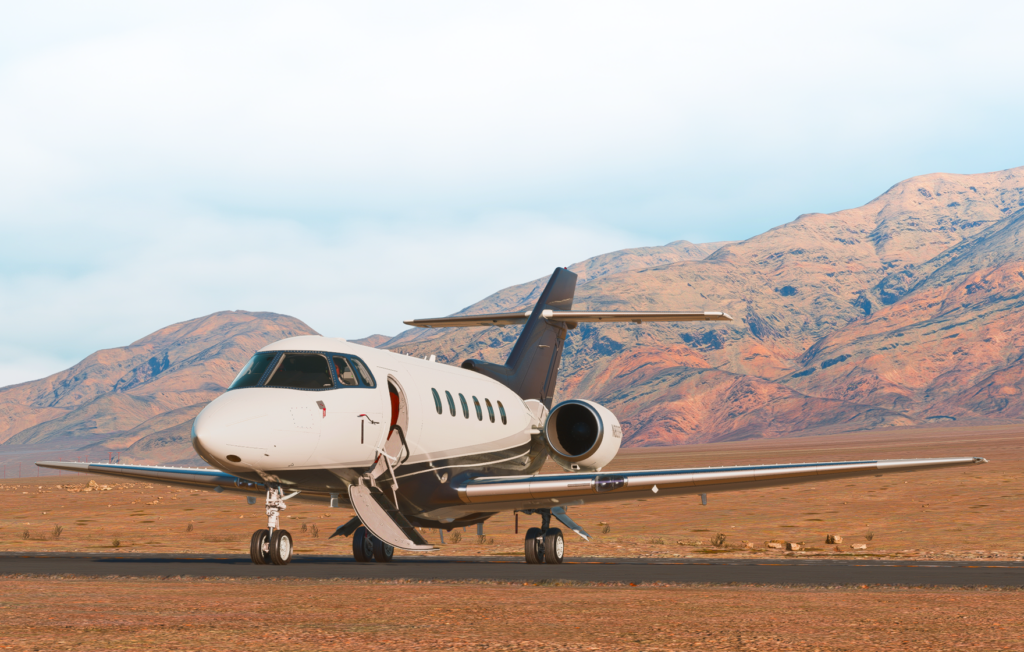
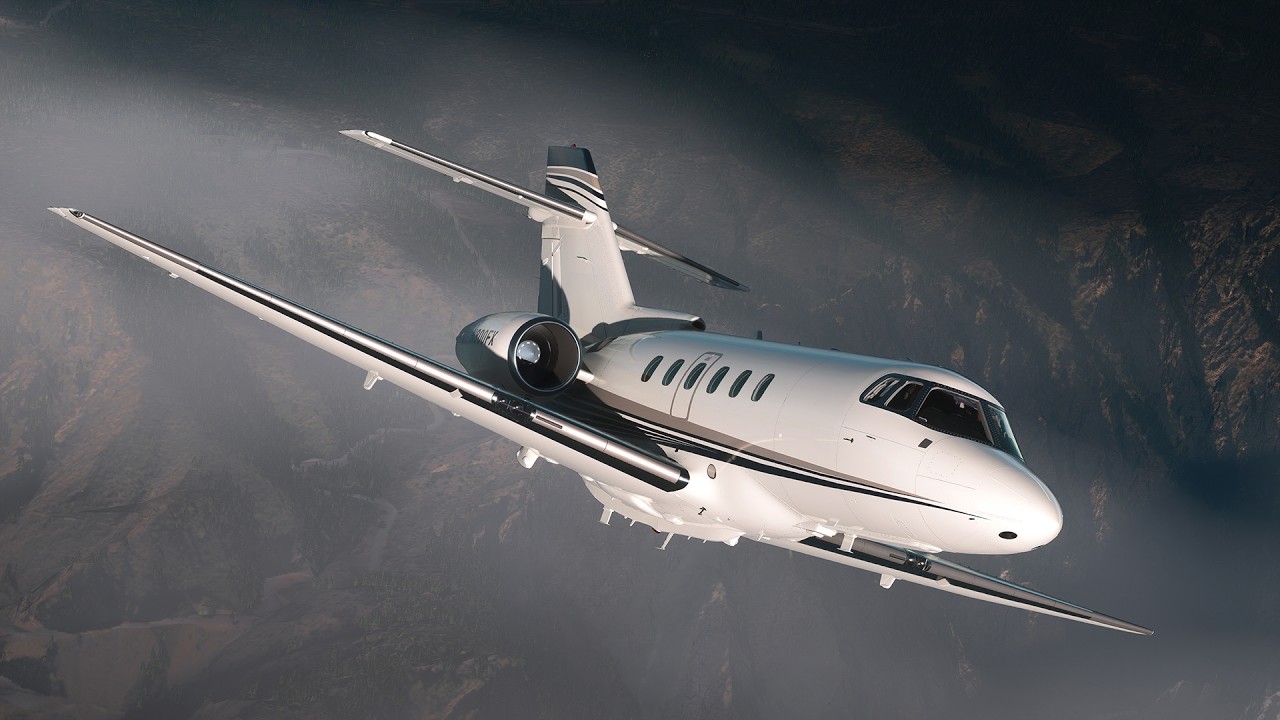
Released earlier this week as part of Microsoft Flight Simulator’s “Exclusive Series”, the Hawker 800XP by FlightFX is now available to purchase in the Marketplace!
We recently interviewed Nick Sdoucos from The FlightFX team to get a behind-the-scenes look at the development of their latest business jet.
Can you tell us about your decision to develop the Hawker 800XP, and what drew you to this aircraft?
The Hawker 800XP felt like a natural FlightFX aircraft. As an airplane, it has been a fixture in business aviation for decades, carries a huge real-world footprint, but hasn’t always received the same love and attention as other, newer business jets.
The 800XP’s character really spoke to the team.. It represents a different era in business aviation where you have a very capable, proven airframe paired with systems that still require active pilot engagement. The Hawker isn’t trying to do everything for you and rewards a simmer’s time spent studying and flying in the aircraft. Microsoft Flight Simulator is built on the joy of flight, and we truly feel the Hawker embodies that joy in a way that few other aircraft can.
Our goal as a team was to capture the Hawker in the real world and translate that experience into MSFS 2024 as faithfully as we could.
What features can players expect, and are there any Easter Eggs?
The feature list for the Hawker is several pages long, so there is probably more here than we could realistically cover in one answer. The FlightFX team put a tremendous amount into this aircraft, and we think it represents one of the most mature products FlightFX has developed to date.
From a systems standpoint, there is a lot going on under the surface. We did extensive work on the hydraulic, fuel, electrical and pneumatic systems, as well as a significant amount of work on the avionics. We also continued developing our Inertial Immersion System, which we first introduced with the Citation X and have further refined for the Hawker.
We completely overhauled VAMS, our electronic flight bag, as well. It now includes a number of monitoring applications and system synoptics that allow you to actually watch what is happening inside the aircraft. You can see systems operating, valves moving and different components responding to what you are doing in the cockpit. There is an educational aspect to it that I think people are really going to enjoy.
As far as Easter Eggs, or maybe just some of the smaller details people might not expect, there are quite a few. The team built a really interesting refuelling experience where you can refuel the aircraft from inside the airplane, and the workflow is modelled around what a real Hawker pilot would actually have to do. We also put some fun detail into the ice protection system, including actually being able to see the fluid weeping across the surface.
We also introduced FlightFX Enroute with the Hawker. It is essentially a passenger-focused moving map experience, similar in concept to the Airshow systems you might see in a real business jet. It provides real-time route tracking and flight information, but we went beyond the map itself. We incorporated passenger announcements based on audio from the actual aircraft and created a whole library of original music for the cabin. There is everything from jazz and country to music inspired by Europe, the Middle East, Central Africa and other parts of the world. It can serve as boarding music or just add a little regional flavor depending on where you’re flying.
Another feature people may not immediately notice is Total Persistence. It can be enabled through VAMS and tracks more than 1,300 individual parameters on a per-airframe basis. The idea is that when you return to that particular airplane, it remembers how you left it. Switches, systems and aircraft state can persist between flights. Leave the airplane sitting in a hangar long enough and it will even start collecting dust.
Those are the kinds of details we had a lot of fun with on this project. There are the big headline features, but there are also a lot of smaller things throughout the airplane that we hope people discover as they spend more time with it.
What particular challenges did you face during development, and how did you overcome them?
One of the interesting challenges with the Hawker was simply how much FlightFX evolved during the life of the project.
Early on, we were fortunate enough to spend time with the actual aircraft in Birmingham, Alabama. We worked on site with a real Hawker pilot, recorded audio, took extensive measurements and photography, and scanned components of the aircraft to give the team as much real-world reference material as possible. From there, we began building the airplane.
At a certain point, however, other projects within the company had to take priority, so the Hawker was put down for a period of time. When we came back to it, both FlightFX and Microsoft Flight Simulator had changed considerably. Our internal standards had grown, our development techniques had matured, and MSFS 2024 introduced an entirely new set of capabilities and expectations.
That meant we could not simply pick up where we had left off. In a number of areas, we had to go backward before we could move forward. There was significant rework on both the 3D and development sides, and we incorporated a number of technologies, processes and ideas that we had either learned or developed ourselves during that time.
In many ways, the Hawker became a toolbox for the future of FlightFX. A lot of what we developed here was built with an eye toward being more robust and more modular internally, so the work we did on this aircraft can help form the foundation for systems and features that will appear in future projects.
Another major influence was our beta team. As development progressed, we brought several current and former Hawker pilots into the group, and their feedback became instrumental in shaping the finished aircraft. They were extremely critical in the best possible way. Their experience forced us to continually revisit things, rebuild certain elements, make corrections and keep refining the airplane until it stood up to the scrutiny of people who actually know the Hawker.
That process undoubtedly created more work, but it also made the aircraft considerably better. In the end, some of the biggest development challenges became the things that helped push the Hawker, and FlightFX as a whole, forward.
Are there any quirks about this aircraft that players should know to operate it successfully?
I actually deferred to our pilots and technical team on this one, because they were much better equipped than I was to answer it. Their reaction was basically, “Where do you even begin?”
The Hawker is very much an airplane where procedures matter. The position of the MAIN AIR valve matters. Pressurization and oxygen controls need to be set correctly. On landing, there is no automatic spoiler deployment or arming, so the lift dump system has to be manually activated by selecting the airbrakes with the flaps at 45 degrees.
Fuel management has its own quirks as well. If there is fuel in the ventral tank, the aircraft is limited to 280 knots. The ventral tank is essentially either fully fuelled or empty, and you cannot land with fuel remaining in it.
The ice protection system is another good example. The Hawker uses TKS fluid on the wings, which means it can actually run out. You have to manage its use with a timer, and the quantity gauge is located over on the first officer’s side, so it is not exactly front and center.
There are plenty of avionics and electrical quirks too. If you are not using the ATS, you need to go into the FMS and properly set the VNAV speeds before they are injected for use on the PFD. If you leave the emergency lights, standby indicator or refueling control panel powered during shutdown, the airplane will very loudly remind you that you forgot something, although it will not necessarily tell you which one. Even the window heat requires the alternators to be online first.
Their overall description was probably the best one: she can be a handful, but she is a lot of fun once you master her.
That is really the key to operating the Hawker successfully. Pay attention to the procedures, use the checklist and learn the airplane. It rewards you for doing things properly.
How long has the FlightFX team been developing the Hawker 800XP, and what did the testing phase look like in preparation for launch?
The Hawker actually started as a fairly quiet project in the background about two years ago. We made good progress on it initially, but as priorities shifted within the company, the project was paused for a period of time.
When we later began reassessing our development pipeline and the order in which we wanted to bring projects forward, we decided it was the right time to pick the Hawker back up. As I mentioned earlier, by that point both FlightFX and the simulator had evolved considerably, so restarting the project involved much more than simply finishing what had already been built.
The testing phase has been pretty intense. We know that no matter how much internal testing you do, there will always be things that get missed, things that need to be adapted for the simulator, or things that only emerge once thousands of users begin putting an aircraft through scenarios you never anticipated.
That said, we wanted to get this one as far as we possibly could before launch, and we were extremely fortunate to have some very enthusiastic Hawker pilots involved in the beta process. They knew the airplane, they knew its workflows, and they were not shy about telling us when something did not feel right.
Their feedback resulted in a tremendous amount of refinement throughout the aircraft. We changed things, rebuilt things, revisited systems and continued adjusting the airplane under a very critical eye. Without those pilots and the rest of our beta team, the Hawker simply would not be the product it is today.
Ultimately, beta for us is not about proving that an aircraft is perfect. It is about putting it in front of knowledgeable people, listening to what they find and pushing it as close to the real experience as we reasonably can before handing it over to the wider MSFS community.
What’s your favorite element about this aircraft, and is there anything else you’d like to say to MSFS players to celebrate its launch?
There are a few things I really love about the Hawker itself. Visually, one of my favorites is seeing it land with the lift dump system deployed. With the dual spoilers up and the flaps fully extended, the entire wing takes on this really distinctive, mechanical look. There is just something very satisfying about watching all of that happen as the airplane settles onto the runway.
I also love the overall character of the aircraft. The Hawker looks and feels like it was built like a tank. It has this incredibly substantial, durable presence to it. To me, it looks like the kind of airplane you would see in a movie where someone has to fly into some remote corner of the world and get the job done. There is just something purposeful about it. It is not delicate-looking. It looks like an airplane that was built to work.
But if I had to pick one thing from this project that means the most to me personally, it would probably be something we created specifically to celebrate the team.
The Hawker became such a deliberate, collaborative effort inside FlightFX. So many people touched this aircraft in one way or another, whether it was development, 3D, testing, documentation, audio, production or the real-world pilots who helped us along the way. To recognize that, we created a special livery featuring the signatures of the people who contributed to the project.
I love that livery because it represents what this aircraft became for us. It is not just one person’s work. There are a tremendous number of fingerprints on it, and I think the finished product is considerably better because of that.
For the MSFS community, I would just say that we hope you enjoy discovering it. There is a lot packed into this aircraft, including plenty of things that may not be immediately obvious on your first flight. Take your time with it, learn its quirks, dig into the systems and have some fun with it. We are incredibly proud to finally put the Hawker 800XP into your hands.
For technical support and documentation for the Hawker 800XP, including the latest manuals, please visit the FlightFX Discord page: http://discord.gg/flightfx
Or visit the FlightFX Website: https://flightfx.io
Microsoft Flight Simulator is available for Xbox Series X|S and PC with Xbox Game Pass, PC Game Pass, Windows, and Steam, and on Xbox One and supported mobile phones, tablets, and lower-spec PCs via Xbox Cloud Gaming. For the latest information on Microsoft Flight Simulator, stay tuned to @MSFSOfficial on Twitter.